
For many smaller organisations, public procurement can feel burdensome, disproportionate and overly complex. That experience is not unique, and it is one we take seriously.
At its heart, the Social Impact framework aims to bridge the gap between purpose-led, socially-focused services delivered by people rooted in their communities and trusted locally, and the public bodies best placed to commission them, including the NHS.
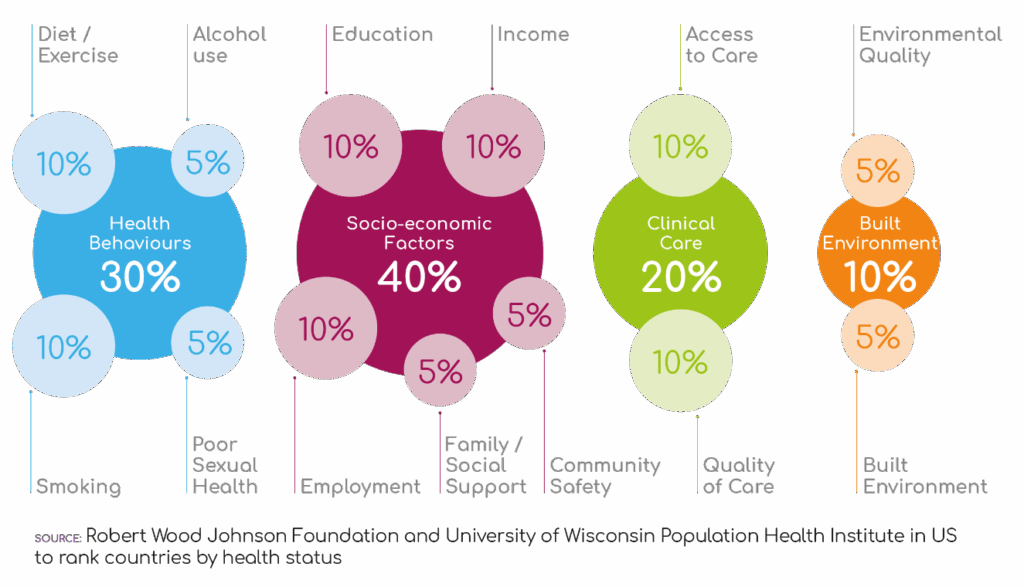
Healthcare doesn’t begin at the hospital door or with a call to 999. Evidence consistently shows that socio-economic factors have the greatest influence on health and well being. Clinical care accounts for only about 20% of health outcomes, meaning the remaining 80% depends on factors including safe housing, good education, fair and sustained employment and strong, inclusive communities.
A research paper commissioned by the Department for Digital, Culture, Media and Sports in 2022 highlights the barriers faced by voluntary, community and social enterprise (VCSE) organisations when engaging with public sector procurement.
Key findings include:
Charity participation in public procurement is limited and concentrated
Around 9,180 charities engage in public procurement, generating £9.2bn (around 5% of total contract value). Participation is closely linked to organisational size, with the majority having annual incomes above £100,000.
Procurement income is dominated by a small number of large charities
Super-major and major charities, approximately 6% of participating organisations, receive 68% of all government contract income (£6.2bn), indicating that most procurement spend flows to larger providers.
Grants remain more common than contracts, but the two overlap
Charities are four times more likely to receive grant funding than contracts. However, those active in procurement also secure almost as much grant funding as the rest of the sector combined, suggesting the two income streams are complementary.
Geography and organisational scale strongly influence success
Larger charities headquartered in London and the South East perform particularly well. Across all regions, charities with incomes above £1m account for over 90% of contract values, reflecting the impact of scale and complex contract design.
Local government is the main gateway for VCSE procurement engagement
Local authorities award the majority of charity contracts (68%) and account for most spend. Engagement with the NHS is more limited, with regional and proximity effects influencing outcomes.
The research points to a clear gap. There is a strong appetite among VCSE and community-led providers to work with the NHS, but the mechanisms to do so are often too complex. With limited capacity and resource, many organisations are simply unable to engage.
This is where the Social Impact framework comes in
Launched on 8 December 2025 as an open framework under the Procurement Act 2023 Light Touch Regime, the framework offers the NHS and wider public sector a route to access small, local providers who have already completed a proportionate assessment process. In principle, this allows commissioners to act with greater agility while remaining compliant with procurement regulations and NHS requirements.
The framework includes 204 successful suppliers across 23 targeted lots, demonstrating clear engagement from organisations delivering services that support wider health outcomes. With options for both direct award and further competition, it is designed to support flexible, place-based commissioning where local needs are best understood.
In practice, however, it has not been easy.
Work on the framework began in February 2025. We held co-design sessions with commissioners, procurement colleagues across NHS systems and local government to shape the framework and understand how it might be used. Alongside this, we ran supplier engagement sessions, formal preliminary market engagement and a follow-up survey to seek clarity on themes identified in the pre-market engagement, identify barriers and understand what could be done to make participation more achievable.
Suppliers told us that tendering is time-consuming and difficult, and that expectations around carbon reduction plans and detailed social value submissions often felt disproportionate. As procurement professionals, we have a responsibility to respond to those concerns, and, within the constraints of regulation, we did.
As part of the first iteration, we:
- Asked for Net Zero commitments rather than full carbon reduction plans
- Simplified modern slavery requirements
- Designed lots to better reflect service expertise
- Limited the number of tender questions and focused on core technical capability
- Used the open framework approach to avoid long periods of exclusion for new suppliers
- Produced a tenderer handbook informed by supplier feedback
- Used clear, plain language throughout the documentation
- Responded to clarification questions openly and constructively
While we’re proud of what has been achieved and grateful for the honesty and engagement shown by suppliers, we recognise that the process is still challenging. There is more to do.
The sheer volume of work involved would be a barrier for many smaller voluntary organisations, particularly without clarity on what they were being asked to bid for.
Our message to the sector is simple: we’re listening
While we can’t change procurement laws or statutory NHS obligations, we are committed to working alongside providers to help navigate public procurement and strengthen the link between place and commissioner. The first iteration of the framework has been a learning experience – and a humbling one at that.
In response to feedback, we will:
- Strengthen pre-tender support through improved guidance, webinars and training
- Develop short videos to help demystify public procurement
- Share learning and success stories across the system
- Avoid reopening the framework during the summer holiday period
- Continue to advocate for community-led, preventative and hyper-local care
The Social Impact framework will reopen on 11 May 2026. Supplier information sessions will take place on 11 March and 16 April (10:00-11:00am) alongside a Social Value webinar on 29 April, open to both current and prospective suppliers.
The Social Impact framework is not a finished product, and it was never intended to be. It’s a practical attempt to create a clearer, more proportionate route for community-led organisations to work with the NHS, while operating within the realities of public procurement.
What we have learned so far has been shaped directly by supplier experience and that learning will continue to inform how the framework develops. Progress in this space depends on collaboration, trust and a willingness to adapt. We are committed to working alongside the sector to ensure that opportunity, not complexity, is what defines the path forward.
To register for the upcoming supplier information sessions, please complete your details using this form.