

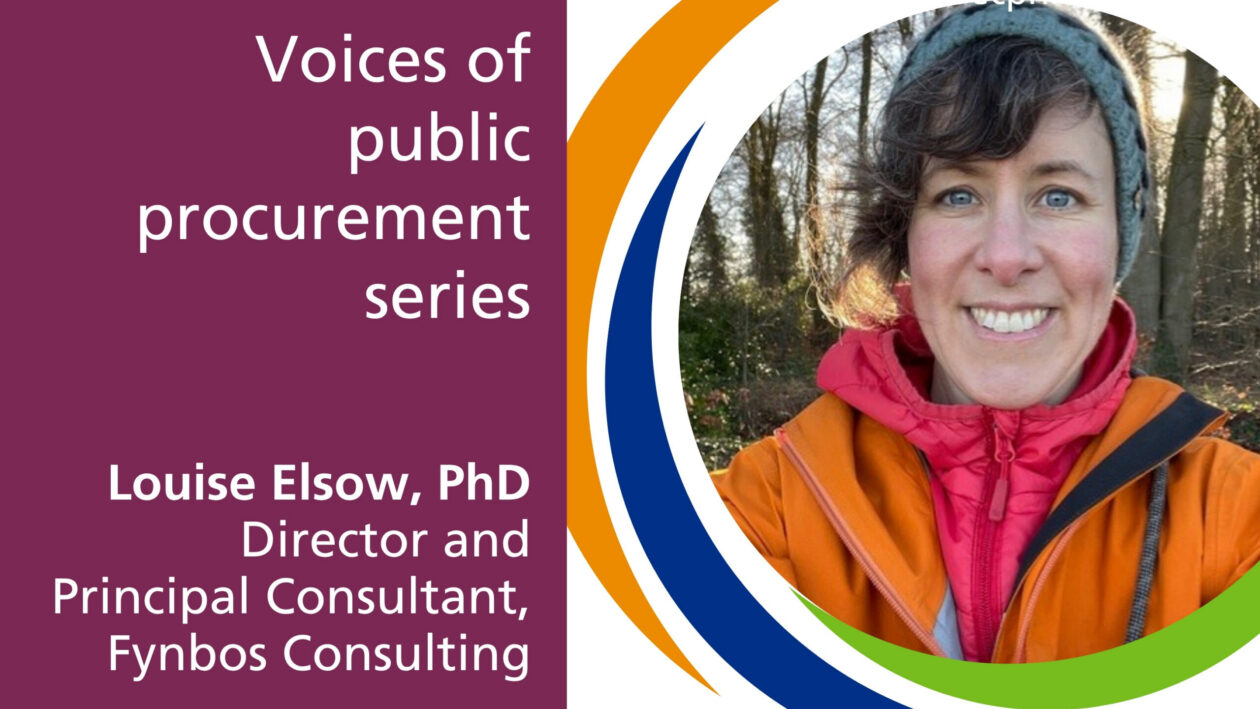
In the second episode of Voices of Public Procurement, Mandy Emery, Sustainability and Social Value Specialist at the East of England NHS Collaborative Procurement Hub, spoke with Louise Elstow, an interdisciplinary social scientist at Cambridge University’s Centre for Sustainable Development. Louise has spent years working across healthcare, transport and critical national infrastructure, helping organisations build resilience to climate change.
From mitigation to adaptation
Most people in healthcare are familiar with sustainability in the context of reducing emissions – cutting carbon, reducing waste, lowering energy use. This is climate mitigation. Adaptation is different.
Adaptation means making procurement decisions today that account for the climate impacts we can no longer avoid. It means thinking about what happens when services flood, buildings overheat or supply chains are disrupted – and planning accordingly.
As Louise explained: “Climate positive adaptation involves everybody from the NHS. Any NHS member of staff can support a more adaptive approach to the use of NHS resources.”
The good news is that the current period of NHS change, though challenging, offers a real opportunity. Redesigning services and ways of working creates space to build adaptation thinking in from the start.
The PEACH project and 12 principles for procurement
Louise’s work on the PEACH project – Project to Embed Climate Change in Healthcare – grew out of a wider European research project on climate adaptation in healthcare settings. Finding that NHS organisations had not been included as pilot sites, she developed a set of resources specifically for NHS procurement and investment.
The centrepiece is 12 principles for adaptation-positive procurement, designed to sit alongside existing procurement processes rather than replace them. The principles help teams at every level – from policy makers to those working directly with suppliers – think more carefully about long-term climate risk.
Alongside the principles, the PEACH project produced the HARK (Healthcare Adaptation Resource Kit). This toolkit offers a range of potential interventions for physical climate impacts, such as flooding and overheating. It helps teams work through which options are most relevant to their setting, in what order they should be taken and how they fit within realistic investment timelines.
Start with your risks
The message Louise returned to throughout the conversation was this: generic commitments are not enough. Organisations need a detailed, site-specific understanding of the climate risks they face.
That means going beyond knowing that temperatures will rise or that flooding is more likely. It means understanding which services will be affected, which demographics are most vulnerable, where equipment might fail and what the consequences for service delivery would be.
“We end up in very generic statements and that doesn’t necessarily help us make better quality decisions,” Louise said. Without understanding the specific risks, organisations may end up investing in interventions that address less significant threats while leaving more serious ones unaddressed.
Her practical advice was straightforward: walk around your site with your emergency planners, risk professionals and estates and facilities managers. Look at the physical landscape. Look at what your existing policies already say about adaptation. Then start to picture what adaptation-positive procurement could look like in your organisation.
Short-term thinking is one of the biggest barriers
Louise identified several barriers to embedding climate resilience across sectors, including healthcare. One of the most significant is a culture of short-term decision making.
When procurement decisions are evaluated only on the basis of immediate cost, the cheapest option will always win. But that approach rarely accounts for the long-term costs of maintaining or replacing assets, the risk of supply chain disruption, or the cost of inadequate protection when a climate event actually occurs.
“Starting small is better than not starting,” Louise acknowledged, “but we really do need to keep the bigger picture in mind.”
She also noted that procurement cannot work in isolation. Climate-resilient procurement depends on designers, engineers, funders and insurers all playing their part. Embedding resilience into procurement means embedding it into the wider landscape of how decisions get made.
The role of shared networks
Procurement forums and professional networks have a concrete role to play. Louise pointed to the value of shared case studies – not just what worked, but why things did or did not work in particular contexts. That kind of nuanced learning helps organisations make better judgements about which approaches suit their own situation.
She also highlighted the importance of building climate considerations into the tools procurement professionals already use – checklists, templates, specifications. When the right questions are embedded in the process, climate resilience becomes a standard part of every conversation, rather than something that depends on one individual in the room.
In a period of significant staff change across the NHS, that matters even more. Processes that live in systems and documents are far more durable than those that live only in people.
Get in touch and listen to the episode
If you would like to find out more about climate adaptation and sustainability in procurement, or to discuss how your organisation can take its first steps, contact Mandy Emery, Sustainability and Social Value Specialist at the Hub, at [email protected].
You can listen to the full conversation with Louise Elstow on the Hub’s YouTube channel and on Spotify.