


A pathway may have one purpose but many homes. We propose placing each function where it adds most value while preserving the relationships between levels.
Executive summary
Neighbourhood health has moved from policy ambition towards delivery. The Neighbourhood Health Framework and NHS England’s work on new delivery models describe neighbourhood, place and system roles. They also outline emerging provider and contracting models. National policy takes an enabling, non-prescriptive approach, allowing local systems to determine models that suit their communities [1, 2].
That flexibility is valuable, but it leaves a practical question. How should partners decide which work is best undertaken close to communities, coordinated across a place or supported at system scale?
This paper proposes an ecosystem approach. It separates pathways into functions such as voice, planning, commissioning, investment, delivery, coordination, assurance and infrastructure. Partners could then assess each function against a consistent set of tests.
This is a discussion paper, not formal policy, commissioning guidance or legal advice. It puts forward a framework for exploration and refinement.
It is written for integrated care board commissioners, place partnerships, provider collaboratives, local authority colleagues and voluntary, community and social enterprise partners. It draws on the Hub’s experience where strategic commissioning, contracting and procurement meet. We welcome challenge and practical testing from partners./
The central proposition: allocate functions, not services.
The framework in brief
| Level | Primary purpose | Distinctive contribution | Starting question |
|---|---|---|---|
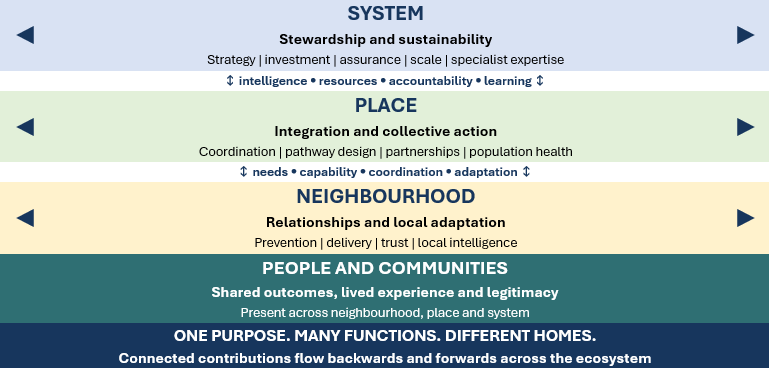
| Neighbourhood | Relationships and local adaptation | Trust, continuity, prevention and local intelligence | What matters to people here? |
| Place | Integration and collective action | Partnership, pathway coordination and population focus | How do partners join this up? |
| System | Stewardship and sustainability | Strategy, investment, assurance, resilience and specialist scale | What must be consistent, sustainable or delivered at scale? |
What this paper puts forward
- A shared vocabulary for neighbourhood, place and system
- A proposed set of allocation tests
- A way to separate delivery from commissioning, coordination and assurance
- A method for mapping voice and legitimacy alongside accountability
- A basis for discussion rather than a mandated operating model
Why an allocation framework is needed
The Neighbourhood Health Framework and NHS England’s related publications establish national direction, broad roles and emerging provider models. They give health and wellbeing boards a lead role in neighbourhood health plans and position integrated care boards as strategic commissioners. They also describe single-neighbourhood, multi-neighbourhood and integrated health organisation models [1, 2, 3].
The Neurological Alliance provides a useful supporting perspective. Its explainer describes broad roles for neighbourhoods, places and systems, while recognising that the three-level model simplifies more varied arrangements. National guidance now defines some responsibilities, but local partners still need to determine how individual pathway functions should be allocated in practice [5].
These sources give partners architecture and principles, but not a complete route for allocating every pathway function. This paper offers one possible way to address that practical gap. It does not assume that one answer will suit every area.
Local flexibility needs a transparent method. Otherwise, flexibility can become ambiguity.
Rethinking the starting question
Asking which organisation owns a service can produce artificial boundaries. A service may span prevention, diagnosis, treatment, rehabilitation and long-term support. Those elements depend on different relationships, capabilities and scales.
A diabetes pathway may involve neighbourhood delivery, place coordination and system assurance. Elective care may include specialist intervention at scale, local diagnostic interfaces and neighbourhood support before and after treatment. Mental health may combine trusted community relationships, integrated place-based provision and highly specialist system services.
We suggest asking a different question. Not ‘Where does this service sit?’ but ‘Where should each function sit, and how must the levels interact?’
A connected ecosystem
This paper uses an ecosystem lens in which neighbourhood, place and system make distinct but connected contributions. Rather than following a fixed direction, intelligence, resources and learning move back and forth between them. This ebb and flow allows functions to adapt as needs and capabilities change, while maintaining clear accountability and a shared purpose.
Conditions that cross every level
| Lived experience | Community voice | Public health | Digital and data | Workforce |
|---|---|---|---|---|
| Estates | Finance | Voluntary, community and social enterprise partners | Health inequalities | Learning and adaptation |
We suggest these conditions are more than supporting detail. They influence whether pathway decisions are workable, equitable and sustainable. They connect levels through shared information, resources, accountability and learning.
Allocate functions, not services
We propose that partners begin by separating a pathway into component functions. Each function can then be assessed independently while remaining connected to the whole pathway.
| Function | Purpose | Illustrative activity |
|---|---|---|
| Voice | Bring lived experience, community priorities and professional insight into decisions | Co-production, engagement and feedback |
| Planning | Understand need and design the pathway | Needs assessment and pathway design |
| Commissioning | Set outcomes, incentives and contractual arrangements | Specifications, payment and market approach |
| Investment | Prioritise and align resources | Funding shifts and transformation investment |
| Delivery | Provide interventions and support | Clinical, care and community activity |
| Coordination | Connect organisations, teams and interfaces | Multidisciplinary working and pathway management |
| Assurance | Monitor quality, outcomes, risk and accountability | Performance, quality and governance |
| Infrastructure | Enable delivery across the ecosystem | Workforce, estates, digital and analytics |
Voice is a function, not an afterthought
Allocating functions may change who needs to influence each decision. No single organisation can represent every form of voice throughout a pathway. Lived experience, community, professional, democratic and strategic voices contribute different knowledge and legitimacy.
| Voice | Contribution | Where it adds value |
|---|---|---|
| Lived experience | How services and barriers are experienced in daily life | Design, access, experience and safety |
| Community voice | Collective priorities, assets and unequal impacts | Prevention and neighbourhood priorities |
| Professional voice | Clinical and operational feasibility | Pathway design and delivery |
| Democratic voice | Health and wellbeing boards, elected members and local accountability | Neighbourhood health plans, place priorities and public value |
| Strategic voice | Sustainability, equity, risk and system impact | Investment, commissioning and assurance |
Critical test: Where does lived experience enter the decision, how does it travel between levels and how can people see its influence?
The ecosystem allocation tests
The tests support structured judgement. They do not generate an automatic answer. A strong signal towards one level does not remove contributions from the others.
| Test | Key question | Primary signal | Watch point |
|---|---|---|---|
| Proximity | Does success depend on trust, continuity and detailed local knowledge? | Neighbourhood | Local delivery still needs common standards |
| Integration | How many organisations, sectors and interfaces must work together? | Place | A broad pathway may need system sponsorship |
| Scale | Does a larger footprint improve resilience, consistency or value? | System | Scale can create distance from communities |
| Complexity | Is scarce or specialist expertise required? | System | Specialist input may support local delivery |
| Voice | Whose perspective is essential to a legitimate and effective decision? | All levels | Consultation is not the same as representation |
| Risk | Where should clinical, financial, statutory and reputational accountability sit? | All levels, with statutory accountability often held at place or system | Clinical, operational, financial and statutory risks may sit at different levels |
| Adaptability | How much should delivery vary with community context and assets? | Neighbourhood | Variation should be purposeful and visible |
| Infrastructure | Does the function rely on shared digital, estates, workforce or analytics capability? | System | Infrastructure must remain usable locally |
| Equity | Is the priority consistent access or responsiveness to distinct local need? | Place or system | Consistent access may require proportionate local investment [7] |
| Prevention | Can earlier community-based action avoid deterioration or demand? | Neighbourhood or place | Benefits may accrue elsewhere in the system |
Suggested decision sequence
We have not yet tested this sequence on a live pathway. We welcome partners who are willing to explore it with us and share what works, what does not and what needs to change.
- Define the person, population and intended outcome
- Break the pathway into functions
- Apply the allocation tests to each function
- Identify the primary level and supporting contributions
- Map voice and decision rights
- Record interfaces, dependencies, information flows and escalation routes
- Test the pathway for gaps, duplication and unintended consequences
- Review the allocation as evidence and capability change
How the lens changes a pathway
The table below uses type 2 diabetes in adults as an illustration. NICE guideline NG28 sets out evidence-based recommendations for individualised care, education, medicines management and complications. The example does not prescribe a local model or describe a complete clinical pathway [11].
Clinical foundation: NICE NG28 provides the clinical reference point. Its visual summary addresses choosing, reviewing and changing medicines; it is not a complete pathway map. Our allocation table explores how supporting functions could be distributed across neighbourhood, place and system. These allocations are the author’s interpretation, not NICE recommendations or an endorsed service model [11, 12].
Scope and assurance: Type 1 diabetes and diabetes in children and young people have different clinical requirements and specialist pathways. This illustration must not be applied to those populations without separate assessment. A proportionate clinical sense-check of the adult type 2 example remains necessary before publication.
| Function | Neighbourhood | Place | System |
|---|---|---|---|
| Voice | Experience of access, self-management and continuity | Population barriers, inequalities and community assets | Equity, outcomes and unwarranted variation |
| Planning | Local needs, access routes and trusted support | End-to-end pathway and partner roles | Strategic intent and population outcomes |
| Delivery | Primary care, pharmacy and self-management support | Community and specialist interfaces | Specialist network support |
| Coordination | Neighbourhood multidisciplinary working | Cross-provider pathway coordination | Network oversight and shared standards |
| Commissioning | Local intelligence and design input | Pathway requirements and incentives | Contract model and strategic outcomes |
| Assurance | Patient feedback and continuity | Pathway quality and access | Population outcomes, risk and inequalities |
| Investment | Local priorities and small-scale prevention funding | Joint investment across the pathway | Strategic resource allocation and transformation funding |
| Infrastructure | Accessible local venues, workforce and digital support | Shared teams, estates and pathway analytics | Common digital standards, workforce strategy and specialist analytics |
The same logic can be applied to mental health, elective care, frailty, discharge, prevention and other pathways. It may also help partners question the assumption that all activity associated with an acute provider must sit at system level. Specialist treatment may require scale, while preparation, transitions, rehabilitation and long-term support may depend on place and neighbourhood capabilities.
Implications for strategic commissioning
An ecosystem lens could shift commissioning from allocating whole services towards designing connected functions and outcomes. It would ask commissioners to examine interfaces, incentives and information flows alongside provider responsibility. Possible implications include:
- Commission for shared outcomes across pathway boundaries
- Separate the location of delivery from the location of accountability
- Make decision rights and escalation routes explicit
- Align incentives where benefits and costs arise in different parts of the system
- Protect local adaptation while identifying what must remain consistent
- Include voice where it can influence decisions
- Test infrastructure requirements before moving activity between settings
We believe this approach need not weaken accountability. It could make accountability more precise by distinguishing operational delivery, coordination, commissioning, investment and assurance.
Implications for procurement and contracting
The Hub works where commissioning, contracting and procurement meet. Functional allocation becomes practical through specifications, provider relationships, payment mechanisms, contracts and assurance. The commercial approach should therefore follow the intended pathway architecture rather than force the pathway into an existing organisational model.
Possible considerations include:
- Whether requirements should be combined, separated or coordinated across providers
- How the Provider Selection Regime applies to each relevant healthcare service arrangement
- Whether payment and incentives support shared outcomes across organisational boundaries
- How contracts record interfaces, information flows, accountability and escalation
- How collaborative commissioning arrangements preserve clear decision rights
Questions for partners
- Which functions genuinely need system scale?
- Where does place add integration rather than another layer?
- Which decisions should be made closest to communities?
- How will patient and community insight move between levels?
- Where could standardisation protect quality, and where could it suppress useful adaptation?
- Who carries risk when functions span several organisations?
- How often should decisions be reviewed as capability and need change?
What needs testing
This framework has not yet been tested through a live pathway redesign. Practical testing should examine whether separating functions improves clarity without creating unnecessary interfaces, handovers or transaction costs. It should also test the analytical capacity required and identify where national requirements appropriately limit local choice.
We propose testing the framework with partners on a small number of pathways. The work should record what changes, what remains fixed and whether the approach improves decisions, accountability and outcomes.
Conclusion
Neighbourhood health is not one service model. It is the meeting point of prevention, care delivery, local government, community assets, strategic commissioning, provider collaboration and public voice. These components retain distinct roles but depend on close collaboration. Their interactions matter as much as their individual design.
National policy provides direction, broad roles and emerging provider models [1, 2, 3]. Local partners must still decide how work should be distributed in practice. A transparent allocation method can help them use that flexibility purposefully rather than allowing unclear boundaries to persist.
We think the challenge ahead is less about deciding which organisation owns a service and more about understanding how different parts of the ecosystem contribute to one outcome.
The framework offered here is an invitation to test, challenge and improve that thinking. Its value will come from use in real pathways and from the voices brought into those discussions.
Contact us
To join the conversation or explore practical testing, contact Sandra Atik:

Acknowledgement and attribution
This paper draws on public policy, guidance, research and commentary about neighbourhood health, integrated care and place-based working. The author has drawn particularly on publications from the Department of Health and Social Care, NHS England, the Neurological Alliance, The King’s Fund, Nuffield Trust and the Local Government Association.
The source organisations retain their intellectual property and copyright. This paper does not reproduce or replace their guidance.
The synthesis, interpretation and proposed framework are the author’s, published by The East of England NHS Collaborative Procurement Hub to support discussion. They are not formal policy, commissioning guidance or legal advice.
What this paper is and is not
| This paper is | This paper is not |
|---|---|
| A synthesis of published insight | NHS England guidance |
| A discussion paper | Department of Health and Social Care policy |
| A framework for exploration and refinement | Statutory, regulatory or legal advice |
| A contribution to continuing debate | A mandated operating model |
Selected public sources
Accessed 9 November 2026. Publication dates and page content remain the responsibility of the source organisations.