


Emergency services rely on fuel every hour of every day. Yet historically, procurement activity was fragmented across organisations, limiting buying power and creating unnecessary duplication.
To address this challenge, BlueLight Commercial and the East of England NHS Collaborative Procurement Hub created a nationally coordinated procurement approach bringing together NHS ambulance trusts, police forces and fire and rescue services under a single fuel card procurement exercise, utilising a Government Commercial Agency framework.
The partnership leveraged collective blue light purchasing power of approximately £138m annual fuel expenditure across more than 86,000 fuel cards and yielded a total of £3,002,495 in savings for the fire, police and ambulance sectors.
The result was a compliant, nationally available mini-competition that delivers lower fuel costs, reduced fees, simplified contract management and a future-ready route for traditional fuels and electric vehicle charging.
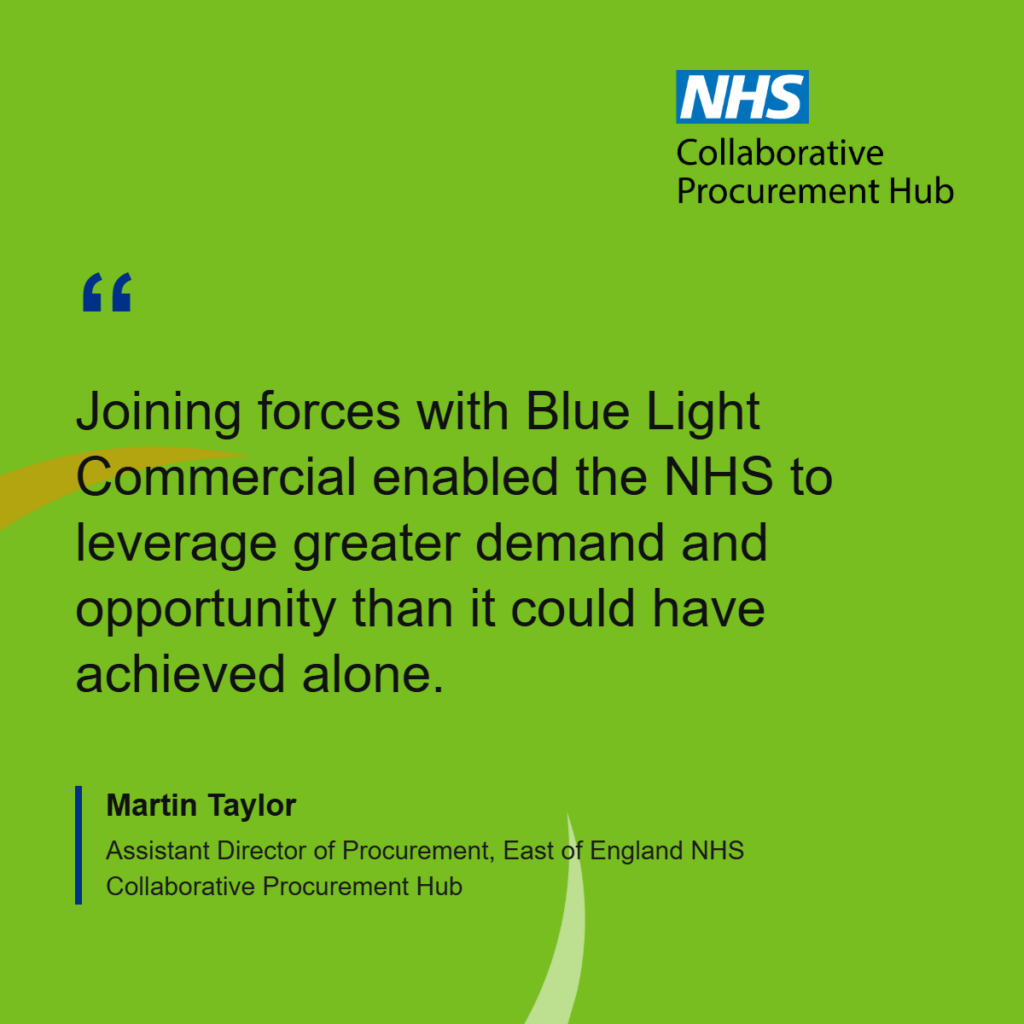
Most importantly, the project demonstrates how cross-functional collaboration between procurement professionals, fleet teams, operational ambulance leaders, finance colleagues, suppliers and national blue light partners can achieve outcomes that no organisation could have delivered alone.

A collaborative partnership
This project was founded on the principle that emergency services would achieve more by working together than acting separately.
BlueLight Commercial, as the national commercial body for policing and working with wider fire and rescue services, led the procurement exercise while the East of England NHS Collaborative Procurement Hub represented NHS ambulance interests throughout the programme. The procurement brought together police, fire and ambulance stakeholders through a dedicated Fuel Card Working Group, ensuring every sector shaped the specification, evaluation approach and future contract requirements
The working group included operational fleet specialists, procurement professionals, commercial leaders and contract managers from across the three emergency service sectors. Stakeholders shared data, identified common requirements and collectively agreed the preferred procurement route.
This collaborative governance model enabled the partnership to speak to the market with a single voice. Rather than 14 ambulance trusts, 43 police forces and multiple fire services pursuing individual procurements, partners worked together to create one solution that benefits the entire blue light community.

Challenges and collaborative solutions
Challenge one: fragmented purchasing power
Emergency services operate significant vehicle fleets and require uninterrupted access to fuel. Prior localised arrangements relied on organisations accessing fuel provision independently, creating multiple duplicated procurement efforts and not being able to take advantage of collective leverage and negotiation opportunities.
Collaborative solution
Partners pooled demand across NHS, police and fire organisations and conducted a single mini-competition through Crown Commercial Service Framework RM6186. This enabled access to national market capability, strengthened supplier engagement and maximised economies of scale.
Challenge two: balancing diverse operational requirements
Ambulance, police and fire services have different operational pressures, fleet profiles and reporting requirements.
Collaborative solution
A cross-sector working group was established to co-design the procurement, enabling each voice to be heard. Stakeholders jointly developed specifications, provided operational insight, highlighted any existing issues to be addressed and participated in evaluation activities, ensuring the final solution met the needs of all sectors while maintaining standardisation.
Challenge three: preparing for fleet decarbonisation
The emergency services sector faces growing pressure to prepare for electric vehicle adoption while operating in a rapidly evolving charging market, underpinned by the government target of Net Zero 2050.
Collaborative solution
Partners deliberately included provision for electric vehicle charging while retaining flexibility, as technology and infrastructure develops. The collaborative approach provided a future-proofed commercial route capable of supporting both traditional fuel and emerging EV requirements.
Innovation through collaboration
The innovation in this project was not a new technology, but a new way of working.
The partnership transformed a routine, fractured, commodity purchase into a strategic national procurement programme.
Instead of organisations approaching suppliers independently, the project aggregated demand across the entire blue light sector. This created a single procurement route offering:
- one card per vehicle
- one organisational account
- reduced administration
- lower fees
- improved fuel savings
- access to both traditional fuel and EV charging solutions
- centralised supplier management
The project also responded directly to stakeholder feedback by encouraging improvements in digital tools, reporting and account management processes. The strategy explored opportunities for mobile applications, streamlined invoicing and improved management information, helping organisations gain greater operational insight and reduce administrative burden.
By combining procurement expertise with operational fleet knowledge, the partnership developed a genuinely user-centred solution.
Delivery of savings and efficiencies
The collaboration delivered substantial financial benefits in excess of those already being achieved locally, with savings for ambulance, police and fire exceeding £3m.
These savings demonstrate the value of aggregating demand and strengthening purchasing leverage through collaborative procurement.
Beyond direct cash-releasing savings, the project delivered significant efficiency benefits.
The partnership removed the need for multiple organisations to undertake separate procurement exercises. It created a compliant national route to market, reduced internal procurement workload and streamlined supplier engagement. The strategy specifically identified reduced administrative effort, streamlined invoicing and improved contract management as core benefits.
The winning supplier also provides nationwide coverage through a single contract solution, simplifying operational management across emergency service fleets.
BlueLight Commercial continues to work with the supplier to ensure the contract delivers best value over the lifetime of the contract, not just at the outset, establishing a set of KPIs and providing a central route for any service issues or concerns. Management Information is at the core of successful delivery, with an enhanced suite of analytics available for all organisations.
Commitment to social value and sustainability
Sustainability was embedded within the procurement approach from the outset.
The procurement strategy required suppliers to demonstrate social value commitments as part of evaluation, including environmental, social and economic benefits.
Partners specifically considered:
- carbon reduction opportunities
- support for EV charging infrastructure
- ethical supply chains
- modern slavery considerations
- long-term transition towards lower-emission vehicle fleets.
By addressing these issues collectively rather than organisation by organisation, the partnership increased its ability to influence suppliers and shape future market development.
The inclusion of EV charging capability within the framework represents an important step in supporting emergency services on their journey to net zero while maintaining operational resilience.
Strong relationships, shared success and project transferability
This project transformed a routine but critical category into a flagship example of collaborative procurement.
It united NHS, police and fire services behind a single objective, created a nationally available procurement route, delivered more than £1 million in ambulance-sector savings and over £3 million in blue light savings, improved operational efficiency, embedded sustainability considerations and established a long-term collaborative model for the blue light sector.
Most importantly, it proves that when procurement, fleet, finance and operational teams work together across organisational boundaries, they can deliver outcomes that improve value for the public while helping emergency services keep vehicles on the road and respond when service users need them most.
This project is a strong example of how a single procurement approach can successfully bring together police, fire and ambulance services to achieve common goals. Through effective collaboration between procurement, fleet and operational teams, supported by supplier engagement, the partnership has delivered solutions that meet operational needs while driving commercial value. The combination of national collaboration and collective buying power has generated stronger outcomes, improved value for money and demonstrated the benefits of working together across the emergency services sector.
Jo Osborne, Senior Commercial Director, Operational Policing – BlueLight Commercial