

The challenge facing systems
Commissioning sits at the centre of system transformation. Integrated Care Boards (ICBs) and partners must balance statutory duties, financial pressure and rising expectations for measurable outcomes.
National guidance is clear in intent. Applying it consistently across complex systems remains the challenge.
Commissioning under pressure
Commissioning sits at the intersection of statutory duties, financial constraints and expectations to deliver measurable outcomes. Systems must respond to each while maintaining clarity and consistency in decision-making.
How decisions move through the system
Commissioning with purpose creates a clear line of sight from policy and decisions through delivery to measurable outcomes for people and communities.
Our model simplifies a complex landscape. It brings together current national policy, system responsibilities and commissioning language into a single, accessible view.
Commissioners are required to navigate multiple sources of direction at both Integrated Care Board (ICB) and system level. This includes:
- law and regulation, which provide the statutory framework
- NHS England (NHSE), which sets out what systems must do
- external advisers, who offer different approaches to delivery
Each plays an important role. However, these perspectives are often considered separately.
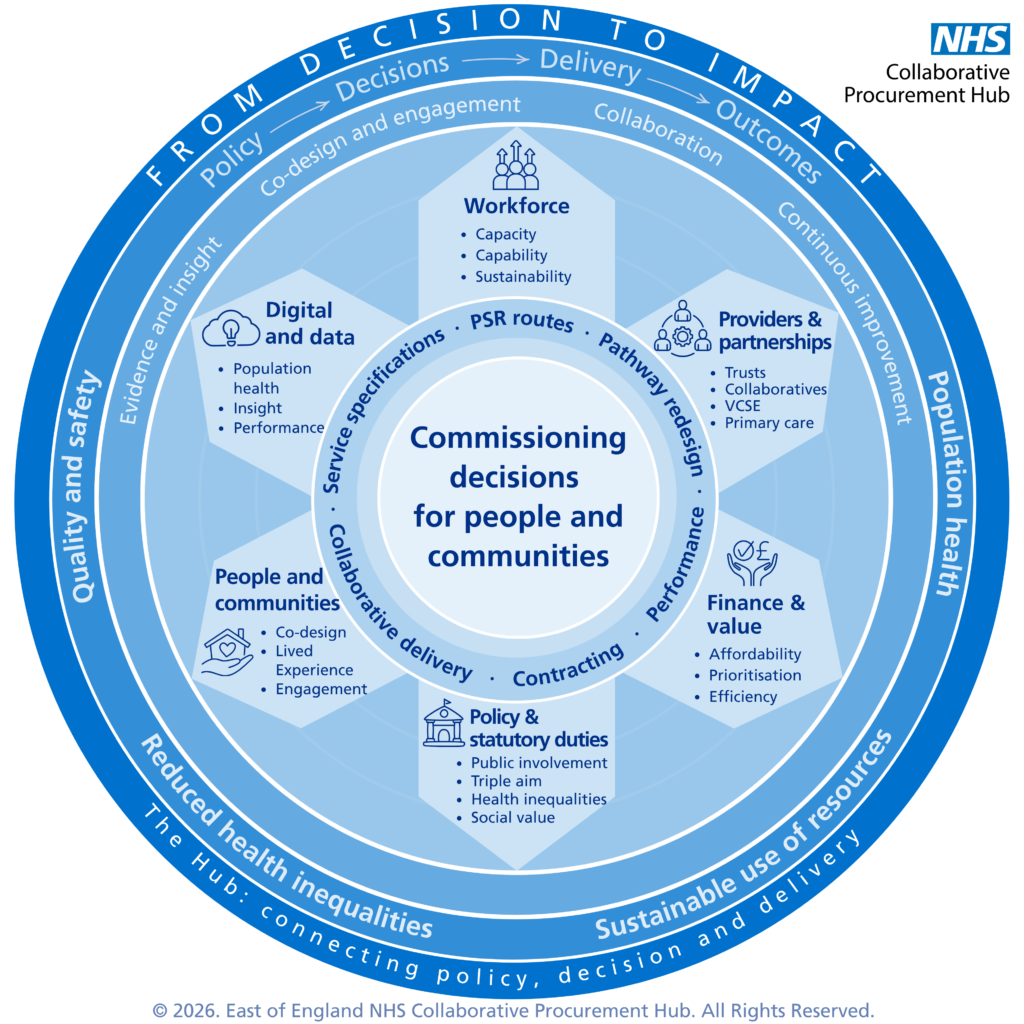
The Hub’s model shows how these elements connect in practice. It sets out how commissioning decisions move through the system to shape service delivery and achieve meaningful outcomes.
Commissioning in practice: connecting policy to outcomes
Commissioning connects national policy, system priorities and service delivery. Decisions made at this point shape how services are designed, delivered and experienced.
Supporting systems to make informed decisions that deliver in practice.
From policy to delivery
Commissioning is not a standalone activity. It connects policy, funding, service design and outcomes across the system.
We work with partners to translate guidance into delivery by linking:
- statutory duties and national policy
- local priorities and financial constraints
- service design and provider collaboration
- measurable improvements in quality, access and outcomes
This creates a clear line of sight from decision to impact.
| Translating national requirements into local action | We work with systems to translate policy into practical commissioning approaches. This moves beyond compliance and focuses on delivery. |
| Public involvement and co-design | We support meaningful engagement that shapes service design, not just consultation. This ensures decisions reflect population needs and can be clearly evidenced. |
| From engagement to co-design | Effective commissioning moves beyond consultation to meaningful co-design. Involving people and communities throughout ensures services reflect lived experience and respond to what matters most. |
The triple aim
Commissioning requires balancing population health, quality and the sustainable use of resources. In practice, systems must make choices, as not all needs can be met at the same time.
We support partners to make clear, evidence-based choices about what to prioritise, for whom and when, ensuring services deliver the greatest impact for local populations.
| Balancing the triple aim in commissioning decisions | Commissioning requires consideration of population health, quality and the sustainable use of resources. These priorities must be assessed together to support effective and equitable decisions. |
| Reducing health inequalities | We work with partners to develop targeted commissioning approaches that respond to variation. This avoids standard models that fail to address local need. |
| Working with people and communities across the system | Commissioning decisions sit within a wider network of partners, including providers, primary care, local authorities and the voluntary sector. Effective commissioning reflects this collective context and strengthens collaboration across systems. |
| Social value and wider impact | We support partners to embed community benefit into commissioning decisions. This aligns services with local priorities and longer-term outcomes. |
Translating policy into commissioning practice
National requirements inform commissioning decisions, but their impact depends on how they are applied. We support systems to translate policy into clear actions that shape service design, delivery and outcomes.
Our approach
We provide flexible, delivery-focused support that adapts to system needs:
- co-designed solutions shaped with partners
- practical delivery across all clinical areas
- alignment with national policy and local priorities
- support at system, place and pathway level
We work alongside teams to strengthen capability and delivery. Our role is to support outcomes rather than operate as a separate consultancy function.
Working alongside systems to deliver in practice
Our approach is collaborative and delivery-focused. We work with partners to understand context, co-design solutions and support implementation. This ensures commissioning decisions are not only well informed, but delivered effectively and sustained over time.
Why this matters
Systems do not need more frameworks. They need support that connects requirements and delivers outcomes in practice.
Our approach focuses on:
- measurable impact for patients and communities
- clarity in decision-making
- consistency in delivery
- confidence in meeting statutory duties
Focusing on outcomes that matter
Commissioning decisions should lead to clear and measurable outcomes. Our work supports improvements in population health, reductions in inequalities, enhanced quality and patient experience and the sustainable use of resources.
Our experience
We have supported NHS England and local systems through every major structural shift. This includes Primary Care Trusts (PCTs), Clinical Commissioning Groups (CCGs) and now Integrated Care Boards (ICBs).
Our roots in Purchased Healthcare (PHC) and the Equitable Access programme underpin a strong track record of consistent, trusted delivery.
Work with us
We work with systems to make commissioning effective, proportionate and focused on outcomes.
If you would like to explore how we can support your priorities, we would welcome a conversation: [email protected]